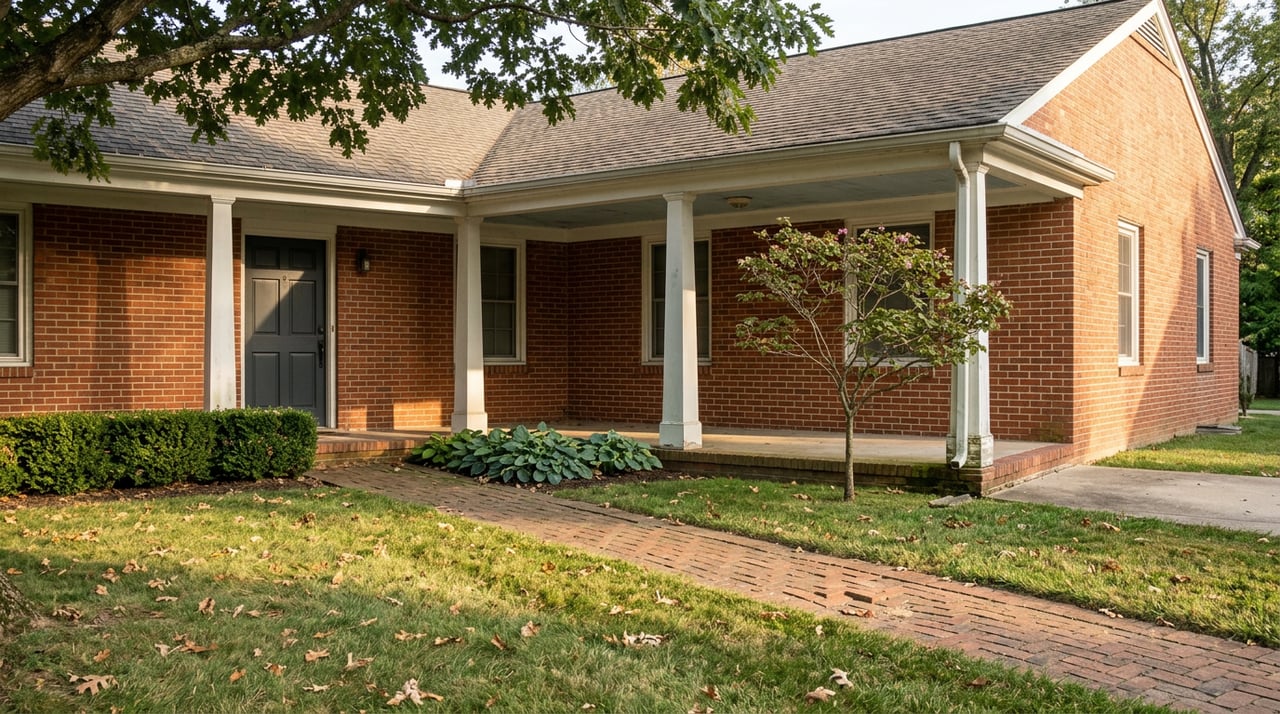
Drive the loop through Bon Air Estates on any weekday evening and the neighborhood reads exactly like it looks on a real estate flyer: brick ranch homes set back from the curb, mature trees leaning over the sidewalks, a street grid that curves instead of grids out. Nothing about it announces a history. But turn onto Proctor Knott Drive, and you're driving down a street named for a horse that once ran on this exact ground, decades before anyone poured a foundation for a ranch house.
Most people who live here have never had a reason to ask why. The name just sits on the sign, unremarkable, the way street names usually are. The answer sits two blocks over, at a restored Second Empire mansion that still uses the same name for one of its guest rooms.
The Farm That Was Here First
Before Bon Air Estates existed as a subdivision, the land belonged to a man named James Bennett Wilder, who built a fifteen-room house here in 1874 and named it Bashford Manor, after his family's home back in England. He hired Henry Whitestone, a Louisville architect, to design it in the Second Empire style popular at the time, and the house anchored what was then Wilder's dairy farm near Bardstown Road.
The dairy operation didn't last. In 1887, industrialist George J. Long bought the property and converted it into a thoroughbred horse farm. That decision is the reason a quiet residential pocket of eastern Louisville carries the racing pedigree it does today.
Three Derby Winners, Bred Where The Ranch Homes Now Stand
Long's operation wasn't a hobby farm. Bashford Manor produced three Kentucky Derby winners in a fifteen-year span: Azra, Manuel, and Sir Huon. That kind of run doesn't happen by accident, and it didn't go unnoticed in Louisville's racing circles. Long became one of the most recognized names in the sport, serving as a director of Churchill Downs, which later named a stakes race after his farm: the Bashford Manor Stakes.
For a stretch of the late nineteenth and early twentieth centuries, the ground under what is now Bon Air Estates was producing Derby winners at a rate most farms in the state never touched. The house that oversaw all of it, the one Whitestone designed for a dairy operation, is still standing.
The Names That Outlasted The Farm
Bashford Manor's stable legacy included other horses beyond the three Derby winners, and two of them left a more direct mark on the neighborhood than most people realize. The restored mansion now operates as Bashford Manor Inn, a bed and breakfast that explicitly honors two of the farm's thoroughbreds, Proctor Knott and Lookout, by naming guest suites after them.
Proctor Knott is also the name on a street sign a few blocks from that inn, running through the residential blocks of Bon Air Estates. It's not a coincidence and it's not a tribute added later. It's a naming choice from whoever platted the subdivision, made at some point after the farm closed, that kept the stable's name alive in the only form a suburban street grid allows.
If you live on that street or one nearby, you're living inside what used to be a working horse farm's boundaries, on a road that still says so.
What Replaced The Track
The land didn't sit frozen after the farm closed. Louisville grew into it in stages, and each stage left something behind:
- Apartment complexes went up through the 1960s, replacing pasture with multi-unit housing.
- Watterson City arrived in 1965 as a commercial development, and by the 1970s it had become the largest suburban commercial center in Louisville.
- Bashford Manor Mall opened in that same commercial push, giving the area a retail anchor it hadn't had before.
- The 1990s brought decline. The mall struggled, and a once-popular multiplex cinema in the area closed.
- The 2000s reset the site again, with a Walmart and a Lowe's built where the mall had stood.
That's four distinct eras of use stacked on the same acreage in under a century and a half, from dairy farm to Derby stable to apartment blocks to regional mall to big-box retail. Bon Air Estates itself, the residential subdivision, is one more layer on top of all of it, the quietest one, and the one still standing today.
What's Actually Around You Now
None of this history changes what a Friday night in the neighborhood looks like. Bon Air Tavern, at 2817 Del Rio Place, opened in 2024 and has settled into the role of neighborhood bar: pool tables, darts, sports on every screen, a patio, and a kitchen that keeps serving until an hour before close. It's the kind of place people mean when they say a neighborhood has a spot.
A short drive out gets you to Syrian Grill and Bistro Le Relais, two of the restaurants that regularly turn up when people ask where to eat near Bon Air Estates. The main strips nearby carry a mix of ethnic groceries and small restaurants that longtime visitors to the area have noted give the neighborhood an unfiltered, lived-in feel rather than a manufactured one.
And if you want to see where the Derby lineage actually landed, Bashford Manor Inn is still taking guests. It leans into its own history now, marketing itself around Kentucky Derby heritage and the two thoroughbreds it named rooms after, with a firepit, a garden, and the same Second Empire architecture Whitestone gave it in 1874. It's close enough to Churchill Downs and downtown that out-of-town guests during Derby week or a bourbon trail run treat it as a base, not a novelty stop.
The Part Worth Remembering
The house that started all of this is still on its original footprint. The street names still carry the stable's horses. The inn still uses those names on purpose, not as decoration but as the actual thread connecting a restored mansion to a working nineteenth-century horse farm that produced three Derby winners under an owner who helped run Churchill Downs itself.
Most subdivisions get built on land that used to be something else. Not many of them keep the evidence sitting on a street sign, a few blocks from a bar that opened two years ago and a bed and breakfast that's been quietly telling this story to anyone who checks in.
Next time you're driving down Proctor Knott Drive, or grabbing a table at Bon Air Tavern, you're not just in a quiet corner of eastern Louisville. You're on what used to be one of the more consequential horse farms in the state's Derby history, and the neighborhood never got around to erasing it.
If you're curious about more of the history layered into Southern Indiana, Louisville-area Kentucky, or the Florida markets Sean Sampson works in, or you just want to talk through what a specific street or block is really like to live on, Sean Sampson is happy to walk through it with you. Let's Connect.